The Modern Paradox of Urbanization
A Look Into Los Angeles’ Wildfires
Urbanization, the movement of populations from rural to urban centers and the physical expansion of cities [1], is often emphasized for its economic benefits. The neoclassical economist has long championed urbanization as a productivity catalyst through agglomeration economies – concentrated networks of labor, capital, and innovation [2]. However, this economic optimism overlooks the environmental and social externalities that unchecked urban growth can impose. Los Angeles, a city that epitomizes the American urban dream, also illustrates its repercussions; the city’s development, driven by policies favoring rapid expansion, has come at the expense of environmental resilience and equitable outcomes. This paper argues that while urbanization has traditionally been viewed as economically advantageous, the case of Los Angeles shows that unchecked expansion creates exacerbated environmental externalities and socioeconomic inequalities, consequences have been made evident in the wake of recent wildfires.
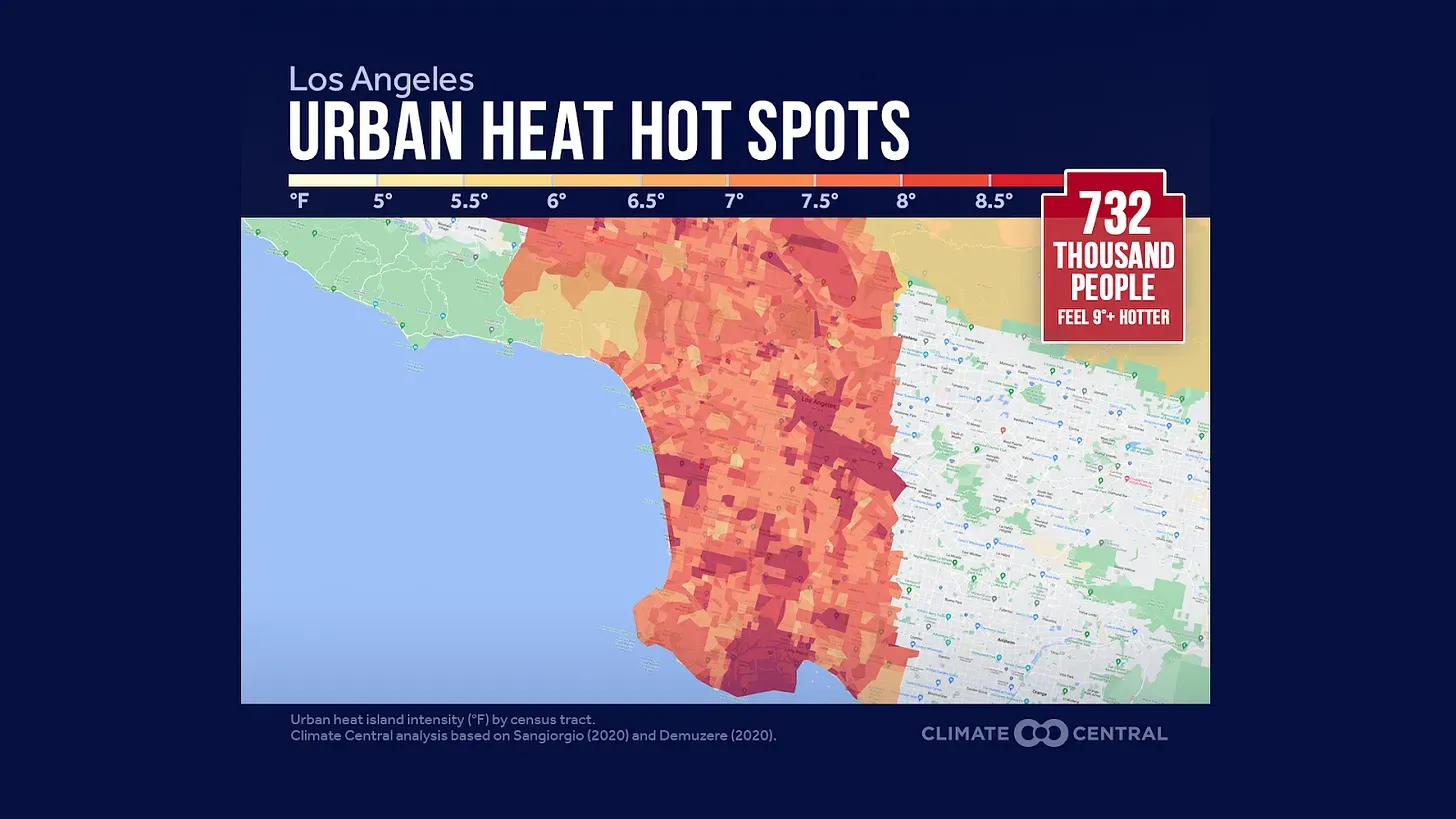
Los Angeles is no stranger to the consequences of its urban sprawl: one of the most pressing and visible impacts of rapid urbanization is the formation of urban heat islands (UHIs). Fig. 1 makes evident that close to one million people in Los Angeles experience an exacerbated artificial heating effect(of nine degrees) due to the effects of urban sprawl. As natural land is replaced by concrete, asphalt, and glass, urban areas absorb and retain significantly more heat than rural surroundings [3]. Los Angeles, in particular, experiences higher surface temperatures due to its limited green spaces – the city experiences temperature differentials of up to 19°F [4]. UHIs not only increase energy demand and greenhouse gas emissions but also exacerbate health risks, especially for lower-income communities that lack access to cooling infrastructure [5]. Closely tied to the urban heat island effect is the loss of natural services – ecosystem functions like air purification, temperature regulation, and water management. Los Angeles’s aggressive urban expansion has degraded its surrounding ecosystems, clearing wetlands and forests that once served as a bastion against extreme weather; as urbanization debilitated these ecological systems, the city lost its natural defenses against such hazards. These losses also diminish long-term stability by increasing the city’s vulnerability to disasters.
The 2024 wildfires exposed the deep vulnerabilities rooted in Los Angeles’ urban design; years of expansion into fire-prone wildland-urban interfaces (WUIs) – transitional zones between unoccupied land and human development – have dramatically increased the city’s fire risk. These areas are often developed due to lower land costs and the appeal of suburban living, but they are ecologically fragile and highly combustible. The recent wildfires burned over 50,000 acres and resulted in a staggering $200 billion cost [6], revealing that the expansion of Los Angeles into fire-prone geographical regions has placed billions of dollars of real estate and infrastructure in high-risk zones – a development pattern that represents a failure in which private benefits generate tantamount public costs. The state’s failure to regulate construction in these zones exemplifies what economists call a market failure: the pursuit of short-term gains at the expense of long-term sustainability and well-being [7].
This market failure is unequally distributed; the burden of the 2024 wildfires fell disproportionately on historically marginalized neighborhoods, particularly in East and South Los Angeles. In areas like East Los Angeles and parts of the San Fernando Valley, the median household has lost approximately 43% of its wealth due to fire-related damages, compared to 12% in higher-income areas [8]. These neighborhoods, often lacking in political representation and infrastructure investment, endured higher rates of displacement, property loss, and health issues related to smoke exposure; this strain on public services is another cost of urbanization that is rarely accounted for in development decisions. Thus, the fires did not just burn landscapes – they illuminated stark socioeconomic disparities entrenched in Los Angeles’ urban geography.
Economists who advocate for sustainable development emphasize the need to integrate environmental and social considerations into economic planning. Sustainable development theory posits that development must meet the needs of the present without compromising the ability of future generations to meet theirs [9]. Los Angeles’ model of urbanization, while economically productive in the short-term, undermines its long-term growth by depleting natural capital and failing to meet sustainability objectives: (1) Urban expansion has resulted in the paving of over 60% of Los Angeles County’s natural watershed area, reducing groundwater by an estimated 307,000 acre-feet annually; this reduction in natural water storage capacity increases contingency on imported water, with associated costs exceeding $500 million per annum [10], (2) The Los Angeles region has lost about 24% of its native plant species since 1940, reducing ecosystems resilience and increasing vulnerability to invasive species [11]; though not easily quantifiable, the economic value of lost ecosystem services is substantial, and (3) Urban development has depleted the carbon sequestration capacity by an estimated 42% since 1950 [12]; this reduction increases the social cost of carbon emission from the metropolitan area, representing a significant negative externality. Then, Los Angeles must increasingly rely on engineered solutions, which are less effective than their natural counterparts and cause a feedback loop of increasing risk and economic damage.
Los Angeles has undeniably benefited from urbanization; it is a global hub for entertainment, technology, and trade. The city has generated millions of jobs, supported cultural diversity, and driven innovation; yet, these benefits come at a growing cost: the environmental destruction and deepening inequality sparked by urbanization threaten the city’s long-term viability. The wildfires of 2024 should serve as a wake-up call: policymakers must shift from a growth-at-all-costs mentality to one that prioritizes ecological restoration, equitable development, and risk mitigation. Strategies may include restricting construction in WUIs, expanding urban green spaces, investing in resilient infrastructure, and enforcing environmental protections. Only then can cities like Los Angeles balance the promises of urbanization with the preservation of life, land, and community.
Columbia Economic Review
Columbia Economic Review
Natalie Yoo~ The Modern Paradox of Urbanization
A Look Into Los Angeles’ Wildfires
Columbia Economic Review
May 05, 2025
Urbanization, the movement of populations from rural to urban centers and the physical expansion of cities [1], is often emphasized for its economic benefits. The neoclassical economist has long championed urbanization as a productivity catalyst through agglomeration economies – concentrated networks of labor, capital, and innovation [2]. However, this economic optimism overlooks the environmental and social externalities that unchecked urban growth can impose. Los Angeles, a city that epitomizes the American urban dream, also illustrates its repercussions; the city’s development, driven by policies favoring rapid expansion, has come at the expense of environmental resilience and equitable outcomes. This paper argues that while urbanization has traditionally been viewed as economically advantageous, the case of Los Angeles shows that unchecked expansion creates exacerbated environmental externalities and socioeconomic inequalities, consequences have been made evident in the wake of recent wildfires.
Los Angeles is no stranger to the consequences of its urban sprawl: one of the most pressing and visible impacts of rapid urbanization is the formation of urban heat islands (UHIs). Fig. 1 makes evident that close to one million people in Los Angeles experience an exacerbated artificial heating effect(of nine degrees) due to the effects of urban sprawl. As natural land is replaced by concrete, asphalt, and glass, urban areas absorb and retain significantly more heat than rural surroundings [3]. Los Angeles, in particular, experiences higher surface temperatures due to its limited green spaces – the city experiences temperature differentials of up to 19°F [4]. UHIs not only increase energy demand and greenhouse gas emissions but also exacerbate health risks, especially for lower-income communities that lack access to cooling infrastructure [5]. Closely tied to the urban heat island effect is the loss of natural services – ecosystem functions like air purification, temperature regulation, and water management. Los Angeles’s aggressive urban expansion has degraded its surrounding ecosystems, clearing wetlands and forests that once served as a bastion against extreme weather; as urbanization debilitated these ecological systems, the city lost its natural defenses against such hazards. These losses also diminish long-term stability by increasing the city’s vulnerability to disasters.
Figure 1
The 2024 wildfires exposed the deep vulnerabilities rooted in Los Angeles’ urban design; years of expansion into fire-prone wildland-urban interfaces (WUIs) – transitional zones between unoccupied land and human development – have dramatically increased the city’s fire risk. These areas are often developed due to lower land costs and the appeal of suburban living, but they are ecologically fragile and highly combustible. The recent wildfires burned over 50,000 acres and resulted in a staggering $200 billion cost [6], revealing that the expansion of Los Angeles into fire-prone geographical regions has placed billions of dollars of real estate and infrastructure in high-risk zones – a development pattern that represents a failure in which private benefits generate tantamount public costs. The state’s failure to regulate construction in these zones exemplifies what economists call a market failure: the pursuit of short-term gains at the expense of long-term sustainability and well-being [7].
This market failure is unequally distributed; the burden of the 2024 wildfires fell disproportionately on historically marginalized neighborhoods, particularly in East and South Los Angeles. In areas like East Los Angeles and parts of the San Fernando Valley, the median household has lost approximately 43% of its wealth due to fire-related damages, compared to 12% in higher-income areas [8]. These neighborhoods, often lacking in political representation and infrastructure investment, endured higher rates of displacement, property loss, and health issues related to smoke exposure; this strain on public services is another cost of urbanization that is rarely accounted for in development decisions. Thus, the fires did not just burn landscapes – they illuminated stark socioeconomic disparities entrenched in Los Angeles’ urban geography.
Economists who advocate for sustainable development emphasize the need to integrate environmental and social considerations into economic planning. Sustainable development theory posits that development must meet the needs of the present without compromising the ability of future generations to meet theirs [9]. Los Angeles’ model of urbanization, while economically productive in the short-term, undermines its long-term growth by depleting natural capital and failing to meet sustainability objectives: (1) Urban expansion has resulted in the paving of over 60% of Los Angeles County’s natural watershed area, reducing groundwater by an estimated 307,000 acre-feet annually; this reduction in natural water storage capacity increases contingency on imported water, with associated costs exceeding $500 million per annum [10], (2) The Los Angeles region has lost about 24% of its native plant species since 1940, reducing ecosystems resilience and increasing vulnerability to invasive species [11]; though not easily quantifiable, the economic value of lost ecosystem services is substantial, and (3) Urban development has depleted the carbon sequestration capacity by an estimated 42% since 1950 [12]; this reduction increases the social cost of carbon emission from the metropolitan area, representing a significant negative externality. Then, Los Angeles must increasingly rely on engineered solutions, which are less effective than their natural counterparts and cause a feedback loop of increasing risk and economic damage.
Los Angeles has undeniably benefited from urbanization; it is a global hub for entertainment, technology, and trade. The city has generated millions of jobs, supported cultural diversity, and driven innovation; yet, these benefits come at a growing cost: the environmental destruction and deepening inequality sparked by urbanization threaten the city’s long-term viability. The wildfires of 2024 should serve as a wake-up call: policymakers must shift from a growth-at-all-costs mentality to one that prioritizes ecological restoration, equitable development, and risk mitigation. Strategies may include restricting construction in WUIs, expanding urban green spaces, investing in resilient infrastructure, and enforcing environmental protections. Only then can cities like Los Angeles balance the promises of urbanization with the preservation of life, land, and community.
Endnotes
1. “Urbanization.” Encyclopædia Britannica, March 29, 2025. https://www.britannica.com/topic/urbanization.
2. Reardon, Sean F., and Kendra Bischoff. “Income Inequality and Income Segregation Sean F. Reardon ...” American Journal of Sociology, Aug. 2008, inequality.stanford.edu/sites/default/files/Income%20Inequality%20and%20Income%20Segregation.pdf
3. Cao, Qian, et al. “Impacts of urbanization on summer climate in China: An assessment with coupled land atmospheric modeling.” Journal of Geophysical Research: Atmospheres, vol. 121, no. 18, 20 Sept. 2016, https://doi.org/10.1002/2016jd025210.
4. Cao, Qian, et al. “Impacts of urbanization on summer climate in China: An assessment with coupled land atmospheric modeling.”
5. Park, Jisung, et al. “Households and heat stress: Estimating the distributional consequences of climate change.” Environment and Development Economics, vol. 23, no. 3, 12 Mar. 2018, pp. 349–368, https://doi.org/10.1017/s1355770x1800013x.
6. Semancik, Alex. “The Economics of a Disaster: How the La Wildfires May Impact the Economy.” OHIO Today, 13 Feb. 2025, www.ohio.edu/news/2025/02/economics-disaster-how-la-wildfires-may-impact-economy.
7. Team, The Investopedia. “Market Failure: What It Is in Economics, Common Types, and Causes.” Investopedia. Accessed April 6, 2025. https://www.investopedia.com/terms/m/marketfailure.asp.
8. Conlisk, Erin, et al. “Evidence of increasing wildfire damage with decreasing property price in Southern California fires.” PLOS ONE, vol. 19, no. 4, 24 Apr. 2024, https://doi.org/10.1371/journal.pone.0300346.
9. Dasgupta, Partha. Economics of Biodiversity: The Dasgupta Review. HM Treasury, 2021.
10. “Sources of Supply.” Los Angeles Department of Water and Power, www.ladwp.com/who-we-are/water system/sources-supply.
11. Szlavecz, Katalin, et al. “Biodiversity on the urban landscape.” Ecological Studies, 22 Dec. 2010, pp. 75–101, https://doi.org/10.1007/978-3-642-16707-2_6.
12. “Carbon TerraVault.” California Resources Corporation, www.crc.com/carbon terravault?gad_source=1&gbraid=0AAAAApQ5RdTwEIYKK6JsC5HBQ39IMwfB-&gclid=Cj0KCQjwkN-- BhDkARIsAD_mnIoepWGvjugTZ6S31A5kmR21HkjTOowuUYOJD8Hflu3mFjvxbWg4kR0aAvOfEALw_wcB. Accessed 17 Mar. 2025.