Spring 2026
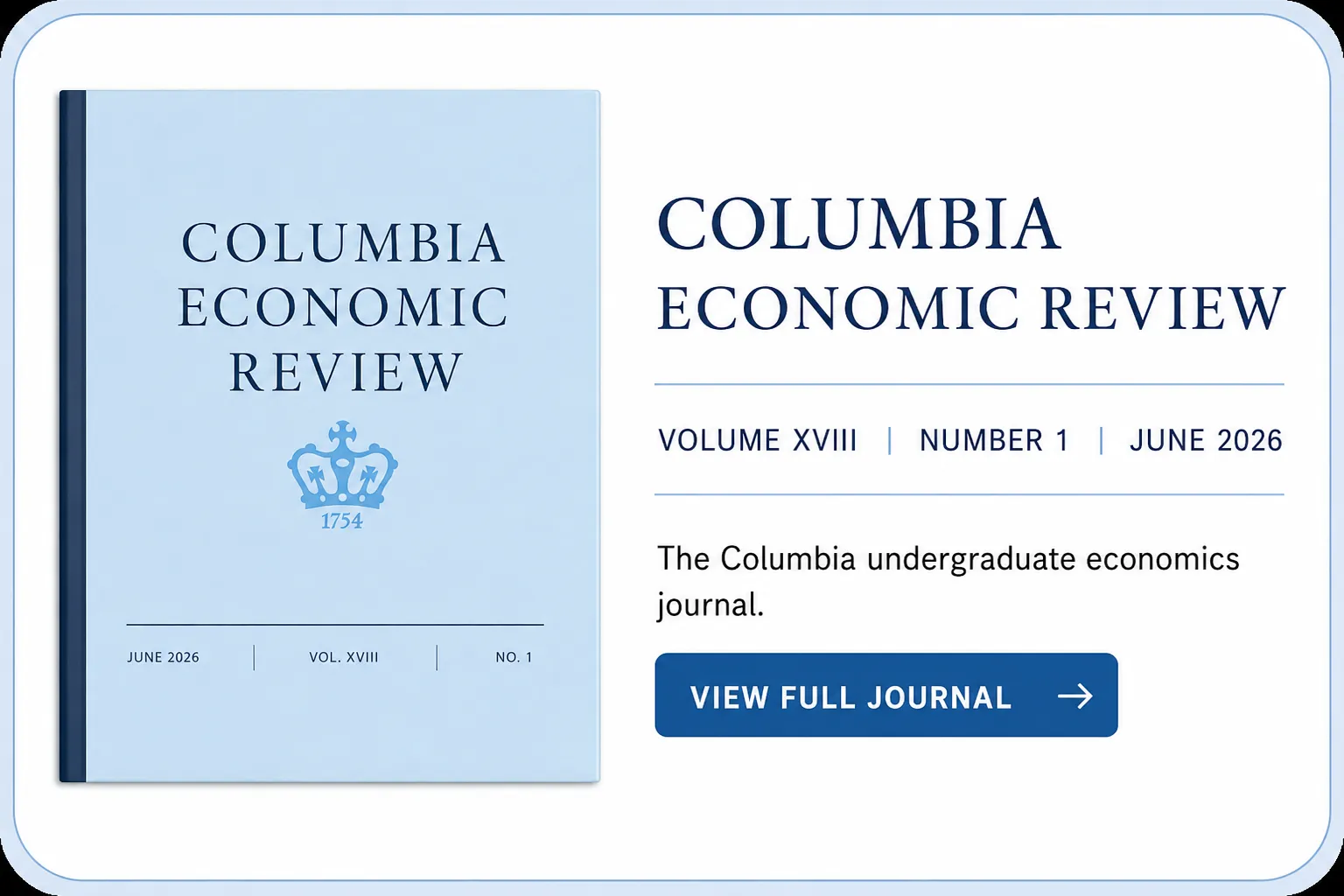
Spring 2025
Financialization and Distrust (Alex H. Zhang)
Reference-Dependent Decision Quality (Chris Shufan Yuan)
Unequal Beginnings: Health Reform and Prenatal Care Disparities in Colombia (Pablo Torres Rey)
Beyond the Headlines: Monetary Policy Transmission to Equity Markets (Ezra Polesky)
How Much Wider Is the Border Now? Revisiting the Border Effect in North America (Sooji Kang)
Journal Submission Guidelines
The Columbia Economic Review is the official undergraduate economics journal of the Department of Economics at Columbia University. We accept original economics research papers written by undergraduates. This could be a paper you wrote for a class, a senior thesis, your own independent research project, or otherwise. Our goal is to give undergraduates at Columbia and other universities throughout the world the opportunity to publish their research in a premier undergraduate academic journal.
Please read our submission guidelines below thoroughly before submitting a paper.
Papers should be submitted via this Google form.
Submissions can only come from current undergraduate students or recent graduates, from any university around the world. We do not accept submissions from high school students.
A submission cannot have already been published in any other journal. Putting your paper on a pre-print server or a similar hosting service is fine. If you submit your paper to us, we ask that you do not submit your paper elsewhere while you await our decision to accept or reject your work.
The main author(s) of the paper must be undergraduate students (or recent graduates). It is okay if you were mentored or advised by a master’s or doctoral student, or a professor.
Current Submission Timeline:
Fall submissions open from 09/04 to 10/04
All authors will receive an acceptance/rejection by 10/18
General Timeline
Our submissions first open in the fall, at the start of the academic year (early September), and are open for roughly 4 weeks. Our editorial staff will inform you of whether or not we choose to accept or reject your article within 2 weeks of submissions closing (if not earlier).
Fall submissions will then be edited and published by December or January. If we deem a submission to be in need of major revisions, we may push that paper into the spring semester.
Our submissions will open again at the start of the next semester (late January), and will stay open for 3 weeks. We will inform you of whether or not we choose to accept or reject your article within 2 weeks of submissions closing.
Spring submissions will then be edited and published by June or July. If we deem a submission to be in need of major revisions, we may push that paper into the following academic year’s fall editing process.
On the use of AI:
We will accept submissions which were aided by the use of generative AI. However, misusing or overusing AI may be to the detriment of your submission.
First, you are responsible for any research outputs that you generate via an AI. You are responsible for any hallucinated citations, you are responsible for any choices an AI coding agent makes while performing data analysis… you must understand all components of the research that any generative AI tool creates for you. We reserve the right to immediately terminate any editing process if we suspect that an author does not truly understand the research they have given us.
Second, while generative AI tools can help speed up the research process, it is often the case that they are overly optimistic or otherwise incorrect about what is truly a novel or interesting economic idea. We strongly encourage you to speak with faculty or other knowledgeable people about whether your research truly brings an original and novel idea to the table.
Third, we highly recommend that generative AI not be used in the writing process. Writing produced by generative AI can be vacuous, circular, and fail to concisely and elegantly convey ideas to readers. Our goal is to disseminate economics research by undergraduates to undergraduates. We are looking for plain, effective language that conveys your research to a wide audience. If you submit a paper which has been largely written by a generative AI, it is unlikely that it will be accepted.
On plagiarism:
Plagiarism, whether intentional or not, is grounds for immediate rejection of your work. Please refer to the Columbia College and Columbia Engineering page on Academic Integrity for more information.
The main contents of the paper (not including your title page, abstract, appendices, or bibliography) should be no more than 40 pages, and ideally should be less than 25. It is the author’s responsibility to trim their work to acceptable levels before submitting.
Please include the name of all authors, university affiliations, and acknowledgements (of advisors or otherwise).
Please include files for every graphic or table included in the paper, in addition to including them in the paper itself.
Please include all code, spreadsheets, or any other data analysis items. Submitting a link to an online archive (e.g. a Github repository) is perfectly fine.
If you have a .tex file, please include it.
Please include an abstract of no more than 350 words.
If your paper is accepted for publication, it will be edited by our journal staff. You will receive feedback and edits on the content, organization, and clarity of your work. We will do our best to provide such comments in a timely manner, and in return we expect that you respond and engage with us in a timely manner as well.
We will notify selected authors after the final decisions have been made. We appreciate all contributions. If you have further questions, please contact us at [email protected].