The Intelligent Space Race
“History doesn’t repeat itself, but it often rhymes,” is a famous quote by American writer Mark Twain, which perfectly describes the situation the world faces today. The world has seen a space race before, when the Soviet Union and the United States raced to develop rocket technology for modern warfare, which then evolved into a race to get a human on the moon. Now, humanity has a new race to the moon, no longer focused on military prowess, but rather on moving artificial intelligence data centers to space. According to Elon Musk at the World Economic Forum meeting in Davos, Switzerland, this January, “The lowest-cost place to put AI will be in space, and that will be true within two years, maybe three at the latest.”
Companies such as SpaceX, Blue Origin, and Alphabet (Google) have begun exploring the prospect of moving their operations to space, citing benefits such as lower cooling costs and increased access to solar energy. Currently, companies spend a tremendous amount on powering their AI models and also providing cooling for these computers. Moving these platforms to space represents the next stage in AI infrastructure development. Looking at the economics of it all, this idea requires trillions of dollars of cash injections into this industry that already burns cash at tremendous rates, and is currently inflating the ‘AI bubble’ that always threatens to pop. This idea protects scarce resources by transferring to renewable energy, but also limits competition across the field. Could we end up having a monopoly over AI by whoever wins the space race? That is the question we seek to explore: whether or not we are safe from a monopolistic market forming.
Elon Musk’s bold statement was accompanied by his company SpaceX, which acquired xAI, showing his intention to integrate AI and space exploration vertically. Furthermore, over the past month, Musk has filed plans with the Federal Communications Commission (FCC) for a one-million-satellite constellation, signalling his serious intent. However, Musk is not the only one who has discussed the prospect of AI moving to space for optimization, which has spurred an already competitive market to move into a new form of competition: the space race. Meanwhile, other major firms are also making moves into space.
Firstly, Alphabet CEO Sundar Pichai has said that Google is exploring “moonshot” concepts for data centres in space. Similarly, former Google CEO Eric Schmidt has cautioned that the industry is “running out of electricity” and has raised the possibility of space-based infrastructure as a long term solution. Google is developing solar-powered AI satellites equipped with its proprietary TPU (Tensor Processing Unit) chips. They plan to launch prototype "machine racks" in orbit by 2027 to test high-bandwidth laser communication between satellites. Looking at a more recent company, Starcloud, which is an NVIDIA-backed startup, already has the ball rolling. In late 2025, Starcloud successfully launched Starcloud-1, a satellite carrying an NVIDIA H100 GPU, becoming the first company to successfully train and run an AI model in orbit, paving the way for the mission that so many other companies are aiming to complete. Therefore, we can see that a lot of the big firms are getting involved in the race, evolving it from mere possibilities to a fully blown new space race.
While this technology would revolutionize the AI industry, does it cause the industry to incline towards a natural monopoly or a very tight oligopoly due to the high costs to produce space-powered data centres? Although the CEOs are promoting ambitious visions of a space-based AI ecosystem, there remain significant technological and political barriers. Moreover, this shift could impose broader economic costs on the AI ecosystem. Global AI spending on data centers alone is projected to exceed $5 trillion. Artificial intelligence projects are currently burning cash at unparalleled rates and are not yet seeing the returns to warrant this amount of spending. The large sums that companies must spend lead to an emphasis on various economic inequalities between the biggest companies and new startups. Startups and smaller companies may struggle to secure funding, even from large venture capitalist (VC) firms, which may not want to enter into such a costly industry. This is especially evident in these scenarios when these ‘bigger players’, such as NVIDIA and SpaceX, are in a position to spend much more and incur a much larger loss than they can afford. Additionally, the company that wins the ‘space race’ may be positioned to capture a significant market share to avoid the Kessler Syndrome. The Kessler Syndrome is a theoretical situation where the number of satellites and orbital debris is so high that collisions occur, each one generating more and more space debris and, in turn, cascading collisions, leaving Earth’s orbit unusable. The fear of this occurrence somewhat prevents the overpopulation of space with various AI data centers.
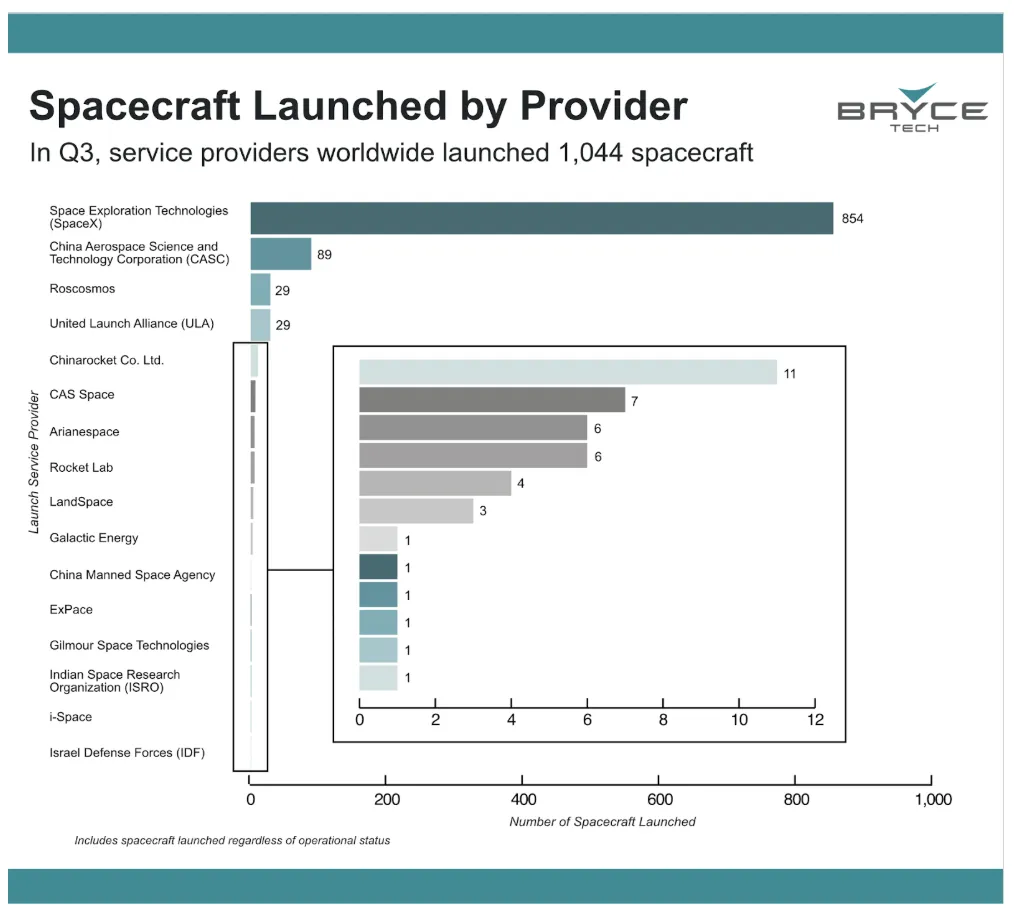
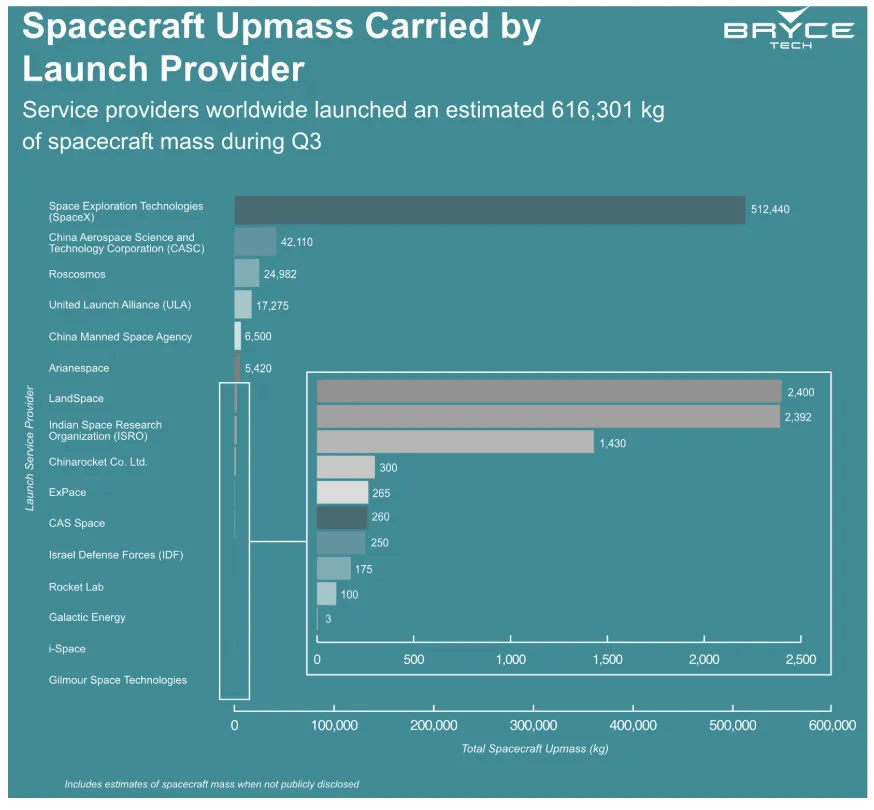
Furthermore, with specific examples such as SpaceX and xAI, the vertically integrated process makes competition difficult for even other big companies. SpaceX controls both the space shuttles and the satellite infrastructure and has a massive advantage in spacecraft launches and upmass (the total mass carried on the spaceship from Earth to orbit). The data below from Q3 2025 show specific values. With SpaceX already being so involved in spacecraft launches, this allows it to deploy data centers at a fraction of the cost of competitors such as Microsoft or Alphabet. Currently, SpaceX also has such an advantage because it has the majority of the government contracts for space exploration. SpaceX was awarded $5.9 billion through 28 of the 59 government contracts for space exploration missions, further pushing them above the competition in terms of available resources.
However, there are many factors that may prevent this monopolistic market from forming. Various powerful countries around the world would object to the United States having a private company controlling the majority of the AI airspace. China, through the Chinese Aerospace Science and Technology Corporation (CASC), the European Union (EU) with IRIS2 (Infrastructure for Resilience, Interconnectivity and Security by Satellite), and India are all launching their own national satellite constellations, despite the high costs, to ensure that they are able to stay up to date with the technological innovations of the US. Additionally, the FCC and other international bodies have been pushing to treat orbital slots as public utilities, thus ensuring that the US is not dependent on a single private organization or citizen to power its entire space AI infrastructure. Moreover, there are major critics of the AI space race as a whole, such as Sam Altman. The OpenAI CEO called the AI space race “ridiculous,” citing the high costs of launching data centers as well as the difficulty of repairing AI in space. He does not see this as a viable option for at least another decade, despite his competitors' ambitiously fast timeframe.
Despite the race to move AI to space, which would provide major cost advantages to whoever is able to achieve this, for the time being, we seem to be safe from a monopolistic market forming in this industry. Moving AI data centers to space is an insanely costly venture that is not truly accessible to all, and certain companies such as SpaceX, already have massive advantages in this regard. This would typically lead to greater concentration in terms of market power. However, through anti-trust laws and international regulation, we seem to be safe from one company taking over the entire AI market, despite the strong reasoning that says whoever wins the race will also control space. Looking forward, if we do end up having AI data centers in the near future, this signals a massive leap forward for mankind, opening up the possibilities for so many more things in space. Who knows, maybe someday we will be registering our businesses on the moon to avoid higher taxes?