Europe’s Industrial Strategy Should Not Become a “Buy European” Policy
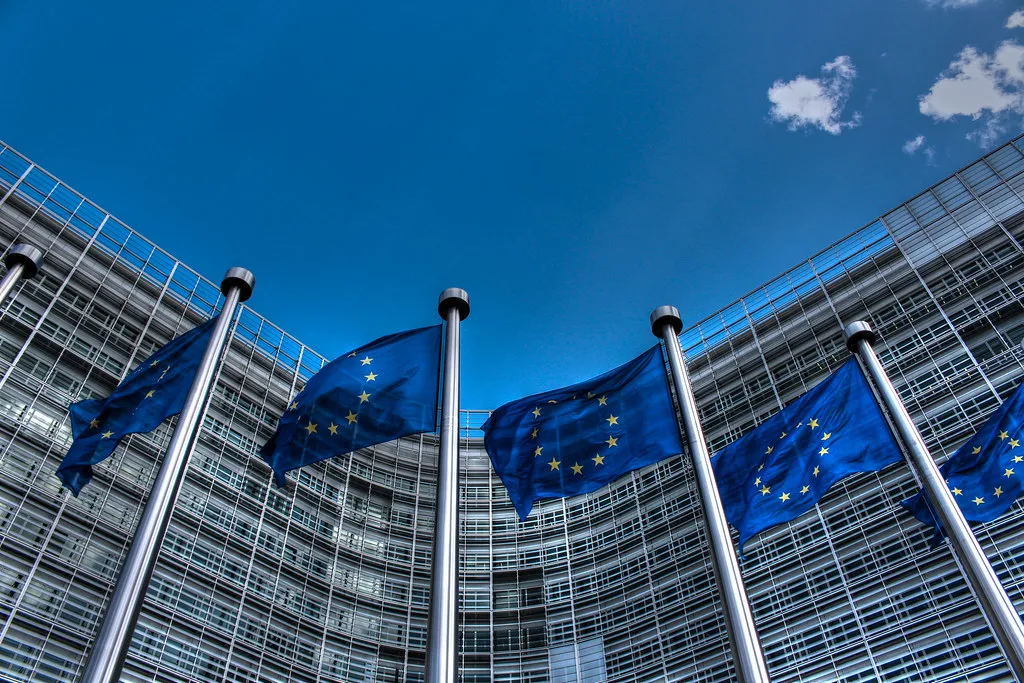
Next week, the European Commission will unveil the draft of the Industrial Accelerator Act, a proposal that could mark a turning point in Europe’s industrial strategy. The policy would condition access to European subsidies on meeting EU-based production thresholds. It would also reshape public procurement rules, the system through which governments purchase goods and services. Under the proposal, national governments would be encouraged to favor bids from firms established within the EU over those from non-EU countries in strategic sectors. Taken together, these measures would shift Europe’s industrial strategy away from its traditional model of open markets and competitive procurement, and instead toward a more geographically restrictive “Buy European” approach.
The impulse behind this shift is understandable. European manufacturing, worth roughly €2.6 trillion, faces high energy costs, intensifying global competition and a more volatile trade environment largely shaped by mounting American protectionism. But responding to these pressures with more protectionism risks exposing European producers to higher costs, threatening the bloc’s competitiveness, and undermining its credibility as a defender of rules-based trade. If resilience is the goal, Europe would be better served by diversification and deeper trade partnerships than by narrowing access to its own market.
Production in the European Union depends on imported inputs. Many European firms import intermediate inputs, process them into higher value-added goods, and then export the final products. This model depends on continued access to foreign components and materials. In other words, European manufacturing is not self-contained. It operates through global supply chains in which production is spread across multiple countries. This reliance is substantial. In 2024, intermediate goods (parts, components, and production inputs) accounted for 58 percent of extra-European imports.
Dependence is especially pronounced in strategic sectors. China supplies 100 percent of the EU’s stock of rare earth elements (REE). Turkey supplies 99 percent of its boron. South Africa supplies 71 percent of its platinum. These materials are essential for green technologies, advanced manufacturing, and defence systems. Mandating that final goods be assembled within the EU does not do anything to eliminate reliance on these external inputs. Strategic autonomy cannot realistically be achieved by narrowing procurement rules while upstream supply chains remain global.
The next issue concerns competitiveness. The Industrial Accelerator Act focuses on public procurement, which accounts for roughly 15 percent of the European Union’s GDP, meaning that governments are among the largest purchasers of goods and services in the EU. If access to procurement contracts is restricted on the basis of geography, fewer firms are eligible to participate. With a smaller pool of bidders, contracting authorities face fewer credible alternatives, and suppliers face less pressure to offer the lowest price or the best performance. As a result, governments may end up paying higher prices for the same inputs, or accepting lower quality, slower delivery, or weaker innovation. Across a procurement market of this scale, sustained reductions in competition weaken efficiency and dampen innovation incentives throughout the EU.
Finally, a “Buy European” approach risks undermining Europe’s credibility. At a time when the EU is critical of the United States’ tariff escalation and protectionism, it cannot adopt similar measures without weakening its own commitment to rules-based trade. As a reminder, the EU is a party to the World Trade Organization’s Agreement on Government Procurement, under which it has committed to grant non-discriminatory access to covered public contracts to firms from other GPA signatories. A broad “Buy European” policy would not automatically violate WTO rules in every case, since coverage depends on sectors and value thresholds. However, it would move in the opposite direction of the spirit of those commitments and risk provoking reciprocal measures. As Mark Carney powerfully observed at Davos, “we shouldn’t allow the rise of hard power to blind us to the fact that the power of legitimacy, integrity and rules will remain strong if we choose to wield it together.” If Europe mirrors American protectionism, it undermines its own credibility as a champion of open, rules-based trade.
Of course, Europe cannot ignore that the global trade environment has become more protectionist and less predictable. The question is not whether Europe should respond, but how. A “Buy European” approach narrows the supplier base to firms located within the EU. That may reduce exposure to certain external risks, but it also concentrates economic activity within a smaller pool of producers and limits competitive pressure. Diversification offers a different path. Rather than shrinking the number of partners, it expands them, reducing reliance on any single country while maintaining access to global inputs and markets.
Trade negotiations with India and the Mercosur bloc matter for this reason. The proposed EU–Mercosur agreement would create one of the largest free trade areas in the world, covering more than 700 million people. The trade structure is largely complementary: Europe exports machinery, chemicals, and pharmaceuticals, while importing agricultural goods and raw materials. Similarly, negotiations with India reflect the logic of building ties with a large, fast-growing economy that offers both a significant export market and alternative sources of industrial inputs and services. Deepening trade relationships across multiple regions enhances Europe’s resilience by spreading risk, expanding market access, and maintaining competitive discipline. Limiting procurement to EU firms, by contrast, does not diversify risk; it confines economic activity to a narrower base and reduces external leverage.
This is not an argument against industrial policy. Governments can and should support innovation, the green transition, and strategic sectors. But a broad “Buy European” approach is the wrong instrument. Restricting procurement risks raising costs, weakening competitive pressure, and eroding Europe’s credibility as a defender of rules-based trade. It sits uneasily with both Europe’s economic structure and its political identity.
Europe’s economic strength has historically rested on two foundations: an integrated internal market that creates scale, and outward-facing trade relationships that provide diversification and opportunity. Resilience has come not from insulation, but from combining internal depth with external openness. Turning procurement into a tool of geographic exclusion would move away from that model. In a fragmented geopolitical environment, resilience is better secured through diversification, partnerships, and sustained competitiveness than by narrowing who is allowed to bid for public contracts.