The Coachella Economy: Driving Growth with Pop Culture
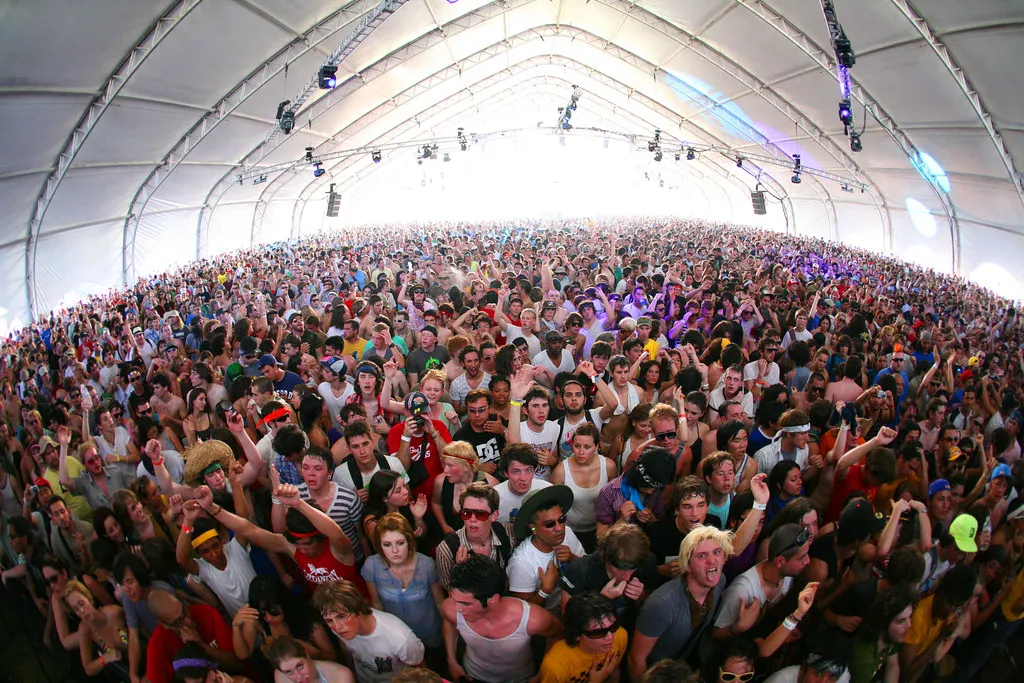
On the map, Indio, California, looks like a sun-bleached patch of desert—one of those quiet places travelers pass on their way to somewhere else. For most of the year, it is precisely that: dry heat, wide roads, and low-slung buildings scattered across the sand. Yet each April, the entire landscape transforms. Hundreds of thousands of visitors, draped in linen, sequins, and a thin layer of dust, descend upon Indio for the Coachella Valley Music and Arts Festival.
For two weekends, capital flows through the town like water. Hotels fill months in advance, local restaurants run out of produce, and Airbnb prices double or even triple. In 2016 alone, Coachella and its country-music counterpart Stagecoach generated an estimated $704 million for the regional economy, including $106 million that went directly into Indio and $3.18 million in ticket-tax revenue—the dollar value of taxes that the city charges on ticket sales. Nearly a decade later, that influence has only strengthened. During the 2025 festival, NBC Palm Springs reported a “major sales boost to Indio and local valley businesses,” with restaurant owners calling it their “make-or-break month.” What began as a modest gamble in the desert has evolved into the financial heartbeat of a city.
Still, Coachella’s importance lies in more than ticket sales or celebrity appearances. The real transformation occurs after the music fades, in the way Indio has turned a fleeting event into a durable economic foundation.
A Festival That Never Ends
When Goldenvoice—a Los Angeles event promoter—organized the first Coachella in 1999, it was hardly a master plan for urban renewal. The company simply wanted to test whether a remote polo field could host a large-scale festival; they began the operations and promotions of a festival and marketed it with names like Morrissey and The Chemical Brothers. Within a few years, Coachella had become a cultural shorthand for youth, art, and a particular brand of creative freedom.
Over the coming decades, the city committed to increasing the support for the festival economy, and they continue to do so: $205 million commitment to capital improvements in the 2025 fiscal year, a recent opening of the 31-acre Indio Sports Park, and the near-completion of the Civic Center Campus in downtown. With the public infrastructure for heightened tourism being developed, private businesses responded in kind: gas stations stayed open later, restaurants extended hours, and short-term rentals spread through nearly every neighborhood. As NBC Palm Springs observed, “...owners say foot traffic and sales have consistently doubled—or even tripled—during the festival weekends”—a seasonal surge that keeps many small businesses afloat through the slower summer months.
Over time, Indio came to embrace the festival as a cornerstone of its civic identity. The city even branded itself “The City of Festivals,” a name that now extends beyond Coachella to include Stagecoach, Desert Trip, and a rotation of smaller art fairs and events. While the economic surge driven by Indio’s keynote festival is remarkable—it is not unique, and it is replicable. For small towns looking to jumpstart a slow economy, the festival-driven model may be something to consider.
The Mechanics of a Modern Boomtown
Coachella functions as what economists describe as an anchor-event economy—a recurring attraction so large that it concentrates both attention and spending in a single location, generating entire ecosystems of complementary businesses. This model has parallels in professional sports franchises, such as the Oklahoma City Thunder or the then-Oakland Raiders, which similarly transform neighborhoods through predictable surges in demand, though Coachella’s reach is broader and more decentralized.
Visitor spending across the Coachella Valley totaled roughly $7.4 billion in 2023, producing about $9 billion in overall regional impact once indirect effects are accounted for. Indio’s portion continues to grow, supported by local policies that funnel festival-related tax revenues into public infrastructure and community services. This is key: collaboration between regulators and event organizers. Through revenue-sharing agreements and event contracting to allow Coachella to take place in Indio through 2050, both Goldenvoice and Indio have contributed to this mutual model that both parties benefit from—and this is something that aspiring towns should note.
The festival’s power extends beyond money. Coachella’s distinct visual language—its glowing installations, desert sunsets, and minimalist aesthetics—has become global shorthand for a certain aspirational lifestyle. Coachella targets younger Millennials and Generation Z consumers, who more and more prefer experiences over luxury goods—and the retro-yet-contemporary glamor of the festival appeals to a consumer torn between trend cycles. Retail brands design “festival collections,” tourism curators borrow their palette, and their images dominate social media each spring. In this sense, Indio exports, not only an event, but a narrative about beauty, freedom, and youth that has turned the city itself into a recognizable cultural product. Small towns that look to mirror Indio’s success need to overcome this hurdle: anyone can start a festival with a few hundred thousand dollars—but that is not enough; the festival must become a cultural moment that draws tourists away from their homes and to the host city.
Additional Successful Cases
Indio’s transformation echoes earlier reinventions. On the island of Ibiza, for instance, tourism reshaped the economy long before global air travel made it famous. Both Ibiza and Coachella took places that were essentially peripheral—an undervalued Mediterranean island and an agricultural desert city—and turned them into global cultural epicenters through the gravitational pull of music-driven tourism. Ibiza’s transformation began in the 1970s–80s as clubs like Pacha and Amnesia attracted European youth culture, eventually creating a year-round nightlife economy that reshaped the island’s identity and infrastructure. Coachella did something similar for Indio: what was once a quiet, low-income farming community became a globally recognized hub for music, art, and fashion after Goldenvoice partnered with the city in the late 1990s. In both cases, the influx of visitors, artists, and media capital turned local economies into experiential destinations.
A similar phenomenon unfolds in the Nevada desert—Burning Man turns Nevada’s Black Rock Desert into a functioning city of tens of thousands every year, complete with its own institutions, art installations, and temporary infrastructure. Coachella does something similar for Indio, but with more permanent economic stakes: the festival anchors hotel development, restaurant growth, and public investment, tying local revenue to the recurring cultural event. Taken together, they suggest a playbook for other overlooked towns: if you can cultivate a distinctive, repeatable experience—whether rooted in music, art, or some other niche—and align it with infrastructure and policy, you can turn geographic “nowhere” into a place people plan their year around.
Together, these examples illustrate a broader truth: modern economies increasingly rely on culture as infrastructure. Whether on a Spanish island, in a Nevada desert, or amid the palm trees of Indio, places that invest in the power of experience often discover that creativity can be as valuable a resource as oil or industry once was.
The Limits of the Party
The story of Coachella is also a reminder that success breeds dependency. When a city’s financial health hinges on one event, its economy becomes incredibly fragile; according to Indio’s 2025 Development Snapshot and Data USA, more than half of the city’s workforce works in blue-collar and service jobs related to the event economy, such as construction and logistics management. Coachella’s cancellations in 2020 and 2021 left Indio without its main source of tax revenue, costing the city about $3 million in ticket surcharges and an additional $1 million in sales and lodging taxes. Across the broader Coachella Valley, the losses reached an estimated $3.1 billion in tourism and hospitality revenue. For a community that calls itself “The City of Festivals,” the silence of those years was beyond economic, and everyone from business owners to everyday people felt the effects. The Riverside City College Viewpoints’ Joyce Nugents reports, “Although many locals don’t work directly in the music industry, businesses ranging from bike shops to food trucks to restaurants disproportionately rely on the festivals for their yearly income.” It is critical for aspiring event-driven economies to manage these risks by not putting their eggs in one basket: the festival or event should be a jumpstarter, but the momentum must not be lost and instead used to strengthen other aspects of the town’s economy and infrastructure.
Even in prosperous years, the benefits are unevenly distributed. While the festival injects millions into local commerce, much of that wealth accumulates at the top—among investors, sponsors, and real estate operators—rather than within the working population that sustains the event. The Coachella Valley’s overall poverty rate remains around 12%, with 18% of children at or below the poverty level. At 20% higher than the overall California rate, Coachella’s child poverty rate is an important thing for the city to consider. It shows that the event-driven economy model is not a magical button—there still needs to be continuous, active development by the host city to improve its citizens' livelihoods. The festivals provide opportunity—but they don’t provide guarantees.
Environmental pressures compound these inequalities. Hosting a quarter-million people in an arid region requires immense quantities of water, fuel, and electricity. Goldenvoice’s sustainability initiatives—solar panels, shuttle systems, waste diversion—represent real progress, yet they cannot offset the ecological weight of such a large gathering. Each April, the desert itself becomes both stage and casualty.
Culturally, Coachella faces the paradox of its own success. The event that once celebrated independent artistry now stands as a symbol of global consumerism. With every sponsorship and influencer activation, a little of its spontaneity slips away. Indio’s challenge, then, is not only economic but also philosophical: how to preserve authenticity in a world that rewards replication.
If the city can channel its festival wealth into long-term investments—schools, affordable housing, green infrastructure—it may yet turn spectacle into sustainability. Otherwise, Coachella’s prosperity risks becoming what the desert so often produces: a mirage that dazzles from a distance but vanishes up close.
Lessons for Other Towns
Communities hoping to replicate Indio’s success can take several lessons from its evolution. The first is that infrastructure precedes identity. Festivals may attract crowds, but without reliable water, transit, and zoning systems, that attention cannot be sustained. Indio’s commitment to logistics laid the foundation for its cultural growth.
The second lesson is that authenticity compounds value. Coachella’s appeal is inseparable from its geography—the heat shimmer, the mountain skyline, the sense of open possibility. Cities that build on what already defines them tend to create brands that feel natural rather than manufactured.
Finally, collaboration strengthens longevity. Indio’s decision to work with, rather than against, Goldenvoice allowed it to keep tax revenue local and transform an annual disruption into a shared civic enterprise. As one official described it, the festival has become “a shared project—part civic pride, part economic engine.”
Beyond Music
Indio’s story is ultimately about adaptation. In a century when manufacturing has dwindled and remote work unmoors people from place, the city found prosperity in culture. Coachella proves that art and experience can serve as economic infrastructure, shaping not just how people spend money but how they imagine a community.
Every town possesses something—history, craft, cuisine, landscape—that can anchor a similar transformation if cultivated thoughtfully. The challenge lies in balancing growth with integrity, openness with restraint. For Indio, that negotiation continues, suspended somewhere between commerce and creativity. What’s clear, however, is that a festival once designed for a single weekend has ended up redefining what an American small city can be.