Big Social Media Platforms are Becoming the Same: Why is this Happening, and What Does it Mean?

Have you ever had to make a decision between services, and wondered what the difference is? Maybe you’re starving at home and swamped with work and need a quick dinner delivery. The three giants stand above all, but what differentiate DoorDash from UberEats and GrubHub? If, somehow, you finally decide, you now need to pay online. Do you use your Visa or Mastercard, or maybe even spring for the American Express this time? Now, let’s say that as we wait we want to do some scrolling on the phone, do we look at brainrot on TikTok, Instagram or X?
This progress of product assimilation raises the question of why so many of these major digital markets “converge.” Is it that only one method works or that everyone has the same preferences? Based on analysis, it appears that digital markets are trending towards homogeneity, but it may create opportunities for new players to enter and play a role in the market. We’ll look at the social media markets, how their products have become so similar recently, the market share that each of these companies have, and what causes the differences between the performance of these companies.
I’m sure that almost everyone in the world with internet access has interacted with social media in some form. Beyond that, the average user has multiple social media accounts across platforms. It’s not an uncommon experience to see someone close Instagram just to browse TikTok or send a snap, but why are these apps becoming so similar, and how do they still retain their user bases? First, let’s examine specific examples of how these platforms are becoming more alike. Snapchat came out with its original ‘story’ feature, which was replicated by Instagram, and then later adapted by platforms like X (formerly Twitter) and TikTok.
According to the article The Rise of Short-Form Video Platforms: TikTok, Reels, and Beyond, TikTok’s success in the early 2020s re-popularized the vertically-filmed short-style video that Vine introduced in 2013. Since then, many have flocked to follow, such as Instagram, Youtube and Snapchat with Reels, Shorts and Spotlight respectively in 2020. The same has been done with so many other features, from direct messaging, to livestreams and integrations with e-commerce, many of these large platforms poach the successful features from their competitors. It is my belief that although these apps continue to compete by poaching each other’s features, society will continue to use a plethora of social media platforms, despite them continually looking more similar.
Intuitively, one might expect this back-and-forth theft of features across platforms would make all of them identical. This constant assimilation may, in a longer run, lead to either only one platform existing or to users choosing their preferred platforms, as in the food delivery industry.
However, with social media platforms, we often see the user base overlapping. Firstly, let’s look at which company currently has the largest market share.
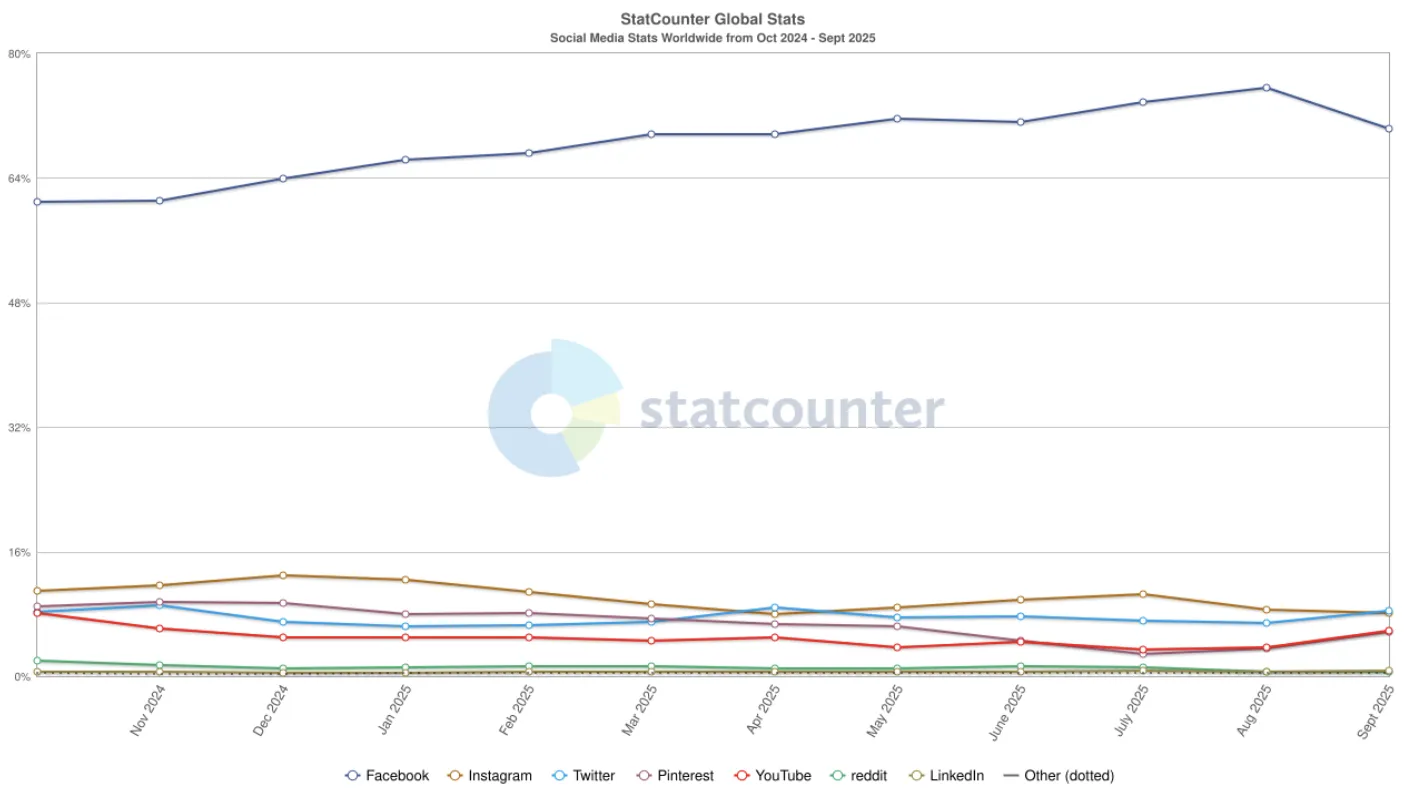
As seen in the diagram above, Facebook has controlled most of the market share over the past 12 month period, at a bit over 64% (based on the amount of traffic each social media site sends to other websites). Looking past Facebook, as one of the oldest and most successful platforms, we can see that a lot of the other big players control much less of the market, ranging from almost 0 to 15%. Evidently, Facebook has been able to maintain its position as the ‘top dog’ despite new platforms emerging with similar features to its original social media app.
However, this may be attributed to Meta’s growth as an external business empire. Interestingly enough, Facebook, despite its declining users, has managed to retain control of the majority of the market share through the acquisition of other popular platforms such as Instagram and WhatsApp, and leading in fields such as e-commerce with Facebook Marketplace. With Facebook as a major outlier, especially given that it owns other major social media platforms such as Instagram and Whatsapp we can see that all of these sites have been able to coexist despite having virtually the same product.
As we’ve seen, there is an almost oligopolistic structure in this industry, with the main players controlling the field with little-to-no competition from those smaller sites who may be present, but pose no real challenge. Although anyone can create an app and try to break into the space, to be truly successful there are definitely high barriers to entry in the industry. Some other platforms exist, but they’re mainly used in niche spaces for people with specific interests. For example, there is Fizz, for specific college campuses; LetterBoxd, for film lovers to share their favourites; and Airchat, an audio-based platform. I’m sure there are people reading this right now who have never heard of some of the aforementioned sites, and that’s not your fault, because they aren’t anywhere near mainstream at all.
Let’s contrast this with an application that was able to grow to quick mainstream success. In July 2023, Meta launched its short text website, Threads, which was seen as a main competitor to Twitter. Within Thread’s first month of operation, they reportedly gained 100 million users, which is a pace faster than the early growth of platforms like TikTok. Threads, while not necessarily the most popular platform there is, is still used and spoken about today, but this obviously has to do with the fact that they were easily able to gain a user base from Instagram with its over 3 billion monthly users. It’s perfectly integrated into Instagram, allowing users to add their Threads tag to their bio, and even displaying Threads posts on the main timeline.
Clearly, the success of this platform while there are other Twitter-like apps that many of us have never heard of such as Mastodon and BlueSky, further highlights the high barriers to entry even though the product is essentially the same. Putting Threads far outside the definition of a ‘social media startup’.
Alternatively, there’s the other side of the coin, with startups that go so against the status quo that they are able to break in. Take BeReal for example, the ‘anti-instagram’ platform that emphasized authenticity in online interactions. The app prompted users at a random time of the day to post a picture of their current surroundings, and marked those who didn’t post within the short time frame after the alert. This example shows a product that went so much against the grain, that it worked and gained high popularity without just reusing the same methods that have been shown to work over the past years.
Unfortunately, BeReal hasn’t lasted long enough to be able to be considered as a real breakthrough in the industry, but it provides a sort of ‘What If?’ case, that shows us it may be possible, but still is extremely difficult to compete with the already established giants. This is because it opens our eyes to what is possible. BeReal was genuinely able to become ‘all the craze’ in a short amount of time and took the world by storm, and it provided an example of the fact that startups actually can come in with innovative ideas and grab user attention from the giants.
However, this still remains extremely difficult as BeReal did not realistically compete for long due to various reasons. According to an article from The Guardian, the app’s monthly users more than halved (from 20m to 6m) between October 2022 and March 2023. It attributes that fall to society becoming tired of the app’s “authenticity facade”, which forced people to share an unflattering picture of their life, or show that they posted late meaning they care about their digital appearance, which goes against the entire point of the app.
The two-minute window to post in eventually became a chore rather than fun. Furthermore, BeReal lacked a clear monetization strategy, and struggled to compete in generating revenue, as many startups do. In the end, although currently trying to come back into the field, BeReal became a summer trend, and resulted with the same fate of another brand partially adopting their features, with Snapchat adopting a dual camera feature in 2022 which allowed users to take pictures with both front and back cameras at the same time like BeReal allowed. Similarly, both Instagram and TikTok introduced features in 2022 that were similar to BeReal that prompted users at random times to post clips, but these features also failed and were discontinued.
So what does this mean for the future? Well, we know that social media markets have been converging for a while. This promotes competition because the big players can all coexist in the market and it forces them to maintain the quality of their app. There remain high barriers to entry that block new ideas from thriving. Even when they do, they haven’t survived thus far.
Going forward this doesn’t signal a real shift from what we see now. These companies are projected to continue growing, and when the ‘BeReal’s of the world emerge, they can’t generate the revenue to compete with these massive players anyway. The homogeneity in the market means that we can probably expect more of the same as time goes on, the oligopolistic firms getting stronger and stronger. As we’ve seen, with Facebook even controlling so much of the market and being allowed to purchase some of the other big players, we could even be trending towards a monopoly.
Research from the Global Web Index shows that social media users aged 16+, on average, access 6.83 different platforms per month. This average rises to 7.71 platforms when the 16-24 age group is examined. This average varies throughout the world, with the highest average in the United Arab Emirates at 8.62 per month to the lowest in Japan at 2.49 per month. These values represent eligible users that are a part of the global internet users and as we can see, even in the countries where users on average access less multiple social media platforms per month, the value is still greater than one.
To accompany this fact, social media use continues to grow yearly, although it has slowed down in recent years. As the number of users across platforms continue to rise, it is my belief that the overlap will continue to grow. Although the features have increasingly become the same, each platform is popular and continues to attract new users, despite the fact that we get the same thing. Ultimately, it seems like consumer choice is gone, if we want to stay up to date, we have to use one of the apps that all have the same features. At least right now we can rest easy knowing that with competitors, they will always improve the quality of the app in a bid to be the best, but maybe it doesn’t matter because in the end, they are all the same, and we will still use all of them.